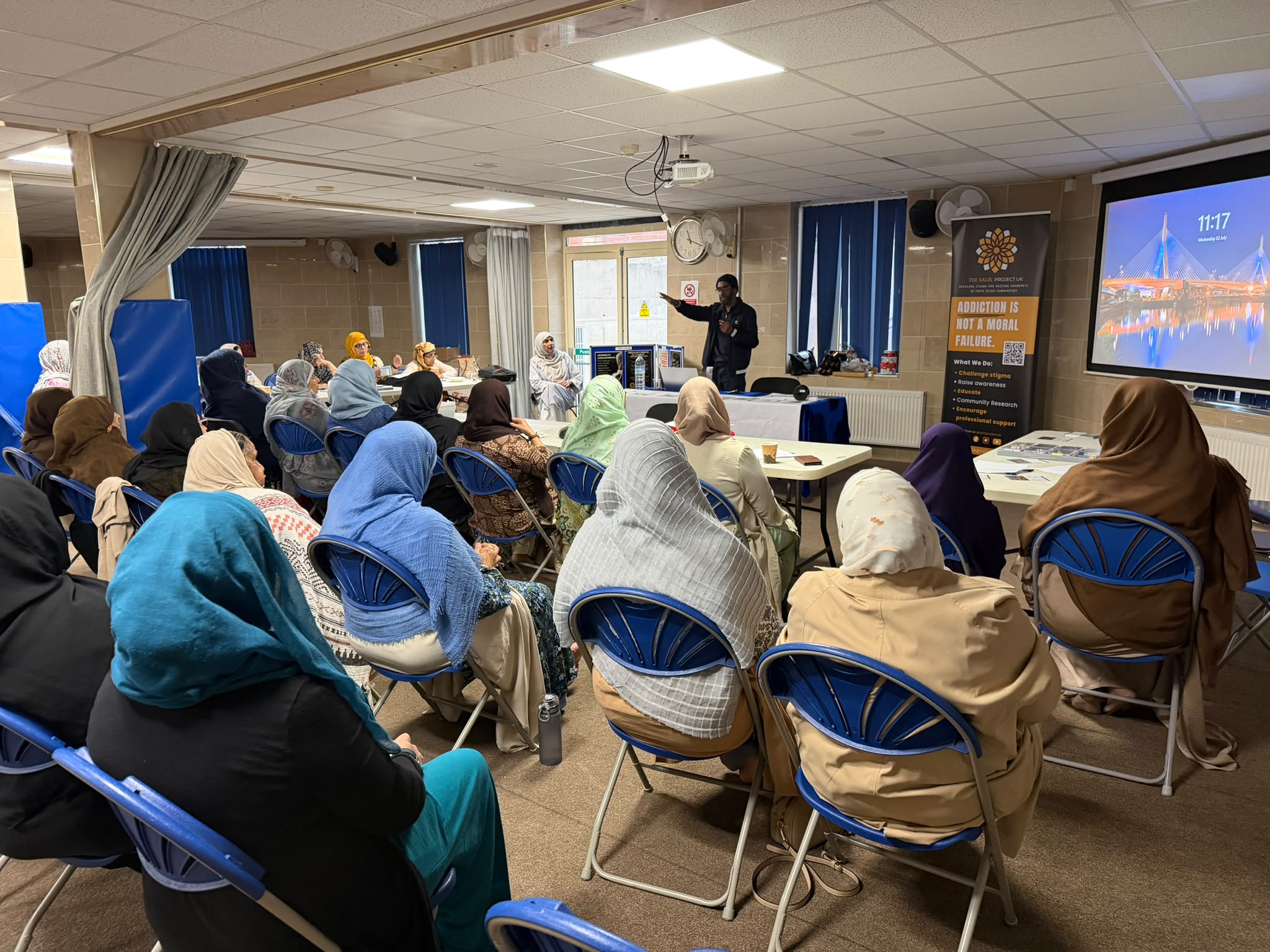
Over the last few months, The Salik Project UK has been working closely with Neeli Mosque to raise awareness of addiction and substance misuse within South Asian communities. Together, we held four sessions: a general workshop on addiction, a session with children divided into two age groups, a women's focus group, and a final debrief to reflect on what we had heard and what should happen next.
When my brother and I started The Salik Project UK last year, we genuinely did not know how the community would respond. From conversations with people working in recovery services, we had been given the impression that South Asian communities could be particularly difficult to engage around addiction.
Our experience has been very different.
We would never claim that one mosque, or the people attending a handful of sessions, can speak for entire South Asian communities. Addiction is complex and every family experiences it differently. But when similar concerns emerge repeatedly, there are lessons worth listening to.
The appetite for conversation is there
One of the strongest parts of the Neeli Mosque collaboration was the involvement of the women. Many were mothers concerned about what they described as a growing problem of drug misuse and drug dealing around their communities and the environment in which their children were growing up.
For them, this was not an abstract discussion about Public Health. It was personal.
The women asked questions, requested more information and told us what they thought we could do better. They wanted further sessions, and we adapted our work in response. Rather than arriving with a standard presentation and leaving, each session developed from the conversations that had come before it.
This takes more work, but we believe it leads to better engagement. Communities should not simply receive awareness work; they should have a role in shaping it.
Listening also means hearing the difficult things
Not every response to our work has been positive. While leafleting at mosques, we have occasionally been told that addiction was "the wrong thing to talk about here".
At another community workshop, an elderly man told us:
"Nothing is going to change. People always come and ask the same questions but nothing ever changes."
He then got up and left.
That comment stayed with us.
It would be easy to dismiss it as resistance, but there is something important behind it. Communities can be asked to attend workshops, focus groups and consultations without always seeing what happens afterwards. If we keep asking people to talk, we also have a responsibility to show where those conversations lead.
The Neeli Mosque collaboration showed the value of building a relationship over several sessions rather than treating engagement as a one-off event.
There is a stage before treatment
Perhaps the biggest lesson for us has been thinking about what happens before somebody reaches a recovery service.
We regularly encounter families who are not yet at the point of making a referral. It might be a mother worried about her son's cannabis use, a family living with somebody whose drinking is becoming increasingly harmful, or somebody who recognises that they have a problem but is not yet ready to seek professional help.
There is a space between awareness and treatment that we need to understand better.
Mosques and community organisations can potentially help fill some of that space: providing reliable information, supporting families, challenging stigma and helping people understand where professional support is available. They should not replace treatment services, nor should they be expected to.
Their value may instead be in helping somebody reach the point where they are ready to take that first step.
Faith can be one of those first steps
We also believe recovery services should be open to the role faith can play in that journey.
People have told us that faith can provide hope, purpose and the belief that change is possible. For some, reconnecting with faith may be the thing that first makes them want to change their life. We should not be afraid of acknowledging that simply because it sits outside the language traditionally used by recovery services.
But faith should not become a substitute for professional support. The opportunity is to connect the two.
If faith opens the door to recovery, professional services need to be ready on the other side.
How we do that needs careful thought and input from mosques, communities and recovery professionals themselves. The balance matters: recognising the genuine hope that faith can offer while ensuring people are encouraged towards practical, appropriate support.
Ultimately, whatever helps somebody take that first step towards recovery, we should be ready for them when they take it.
Building bridges
This is why we believe there is an opportunity for stronger relationships between mosques, grassroots organisations and professional recovery services.
Mosques know their communities. Recovery services have specialist knowledge, treatment infrastructure and safeguarding responsibilities. These should not operate as separate worlds.
A mosque does not need to become a recovery service. But people within a mosque can understand addiction, feel confident talking about it, know what support exists locally and have somewhere trusted to refer somebody when they ask for help.
The relationship should also work both ways. Recovery services can learn from grassroots organisations about the cultural, family and practical barriers people describe when discussing addiction.
There will also be people who prefer to seek support completely outside their own community because of stigma or fears about confidentiality. That choice must be respected. The aim is not to create a single route for South Asian communities, but to create more routes into help.
Keeping the doors open
The work with Neeli Mosque has reinforced our belief that there is an appetite within our communities to talk about addiction. The question now is how we turn those conversations into something sustainable.
Workshops and focus groups can start conversations, but they need something behind them: people with the right knowledge, stronger relationships with treatment providers, clear referral pathways and sustainable support for the grassroots organisations doing this work.
For The Salik Project UK, success is not about making mosques and communities dependent on us. We want them to become increasingly confident in having these conversations themselves, while knowing where community support ends and professional treatment begins.
I often say that:
If there is no door available, we should not expect people to walk through it.
Our experience with Neeli Mosque suggests that, for some people, a mosque, women's group or community organisation may be the first door they are prepared to approach. Faith may give somebody the hope to open it. Professional services can help them with what comes next.
Our collective responsibility is to make sure those doors remain open — and that they lead somewhere.
We would like to thank Tanzila, Abida, Imam Syed, Imam Yeamin and Dr Saif, alongside everyone at Neeli Mosque who participated, challenged us and helped shape this work.