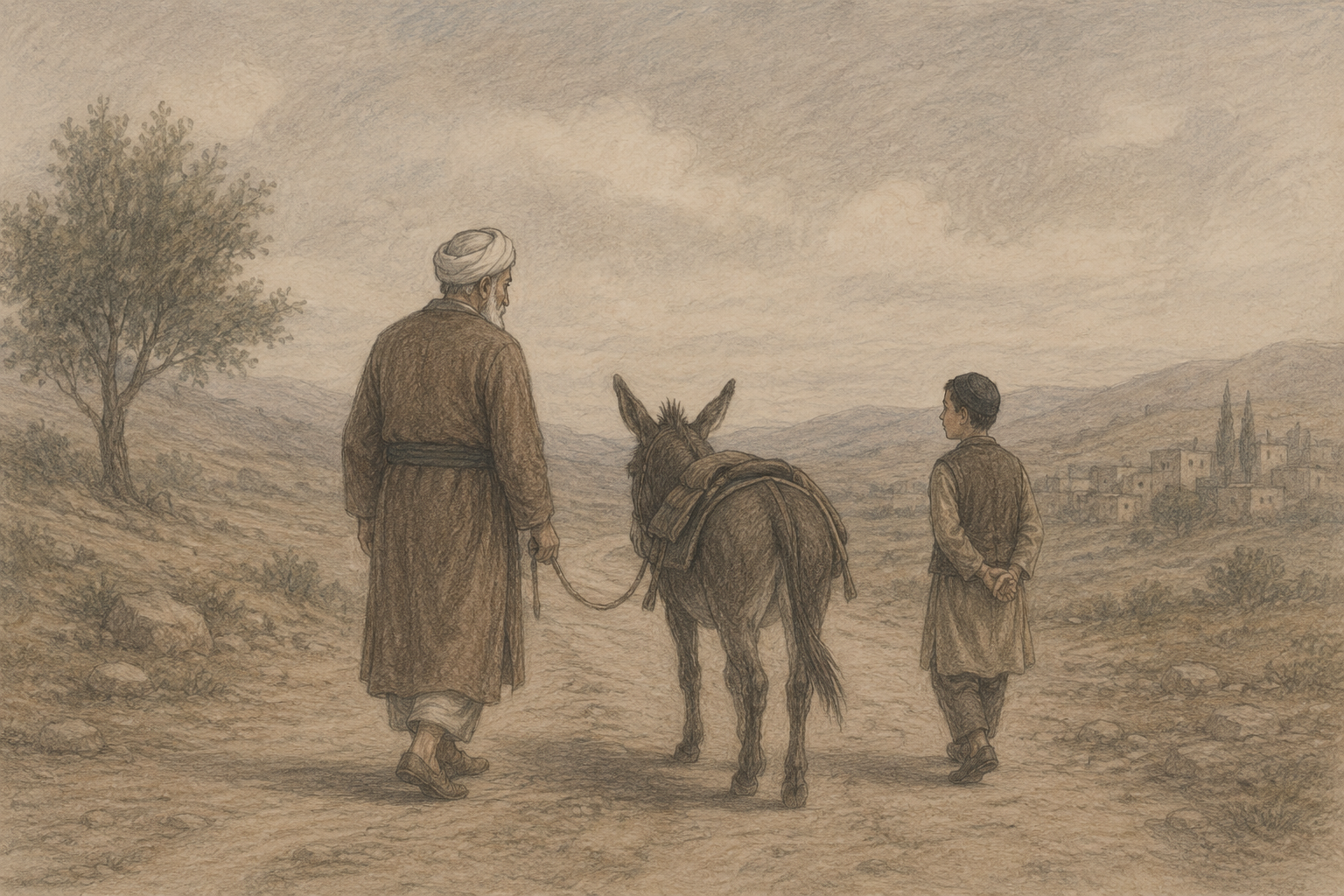
Those familiar with Islamic folklore will have come across the figure of Mullah Nusruddin, or Goha as he is otherwise known. One particular, well-known story has always stayed with me.
Goha had a son who was constantly worried about what people would think of him. Wanting to teach him a lesson, Goha saddled his donkey and set off with his son to a neighbouring village.
At first, Goha rode the donkey while his son walked behind. Some people saw them and remarked, "Look at that heartless man making his son walk." So Goha climbed down and let his son ride instead. Soon enough, another group criticised the boy for showing no respect to his elderly father.
Trying to avoid criticism, father and son both rode the donkey together. Yet others condemned them for being cruel to the animal. So they both dismounted and walked beside it. This time they were mocked for not using the donkey at all. Finally, in frustration, Goha suggested they carry the donkey. As they staggered along, passers-by burst into laughter.
"Whatever you do in life, people will always have something to say. You can never please everyone."
I've always understood this story as a critique of shame; of the way we contort ourselves to satisfy the expectations of others and the cultures in which we are embedded. For the South Asian addict, the experience of courageously "coming out" to family — and by extension the wider community — can feel very much like this journey with the donkey.
Familiar dynamics, unfamiliar weight
In many ways, South Asian family dynamics are not so different from those found elsewhere. Parents want the best for their children. Children seek the approval of their parents. These are universal experiences. Yet alongside these familiar dynamics sits something more difficult to articulate: the enduring weight of honour, reputation, and the ever-present question, "What will people say?"
From a young age, many of us are taught that our actions reflect not only on ourselves, but on our entire family. Success becomes a collective endeavour and failure a collective embarrassment. As adults, many of us find ourselves trying to unravel where this burden comes from. It can feel as though we are suddenly handed a baton in a relay race that began generations before us, expected to keep running while all the eyes of family and community remain fixed upon us.
An inherited weight
For me, being the child of immigrants has much to do with understanding this inheritance.
Our parents and grandparents left small villages in Pakistan and arrived in Britain with hopes of a better future. They worked in textile mills, opened corner shops and takeaways, drove taxis, and sacrificed enormously. In those early decades, many men came alone, with wives and children joining later. Their responsibilities extended far beyond the nuclear family. They supported relatives back home and, in some cases, entire villages.
Individual success was never simply individual. It was bound up with the success and reputation of the wider clan. Alongside sacrifice came powerful ideas around honour and shame. Over time, these concepts became so deeply ingrained that they were inherited by the next generation, often unconsciously. What was passed down was not necessarily a deliberate philosophy, but a crystallised mentality formed by hardship, survival, and responsibility.
None of this is to blame our parents or grandparents. They carried burdens many of us can scarcely imagine. But inherited ways of thinking do not become immune from reflection simply because they were born from sacrifice.
What Goha's story reveals
Goha's story reveals something profound. Public opinion is fickle. What one person praises, another condemns. In trying to avoid criticism, Goha and his son gradually surrender their own judgement until they end up doing something absurd — carrying the donkey itself. The story gently mocks the power of gossip and reminds us that those who criticise rarely offer solutions. It also teaches that self-worth cannot be built upon universal approval because universal approval simply does not exist.
For those struggling with addiction, shame can become a prison. Fear of dishonouring the family, fear of community gossip, and fear of bringing embarrassment upon loved ones can force suffering underground. Problems that require compassion and support become hidden behind closed doors. Silence becomes mistaken for dignity, and appearances become more important than healing.
Something is changing
There is still much work to do. As an organisation operating on a shoestring, we are trying our best to collect the stories and the data to gain a broader insight into the problem of substance misuse within South Asian communities. We are acutely aware of tokenism and being held up as a model of South Asian lived experience that is reduced to a sob story rather than a catalyst for practical solutions and change.
The main challenge still remains one of giving people the confidence to let down their emotional guard within a cultural context that has been for far too long governed by silence, shame and honour. In other words, part of the education and awareness work we are doing within South Asian communities involves helping people unlearn ideas that have, often unconsciously, become woven into the very fabric of South Asian identity.
But something is changing.
Across Rochdale, we are beginning to witness a new generation of young South Asians — and South Asian women in particular since honour is often squarely laid at their door — taking up the mantle. They are not rejecting their culture, nor are they dismissing the sacrifices of those who came before them. Rather, they are asking difficult questions with honesty and compassion. They are challenging the idea that honour is preserved through silence and recognising that true dignity lies not in pretending problems do not exist, but in facing them together.
Young people are increasingly rejecting the tyranny of "What will people say?" and replacing it with a more important question: "What can we do?" At the same time, women are challenging shame and breaking free from the constraints of harmful notions of honour.
Instead of protecting reputations at all costs, they are protecting lives. Instead of allowing shame to dictate the conversation, they are choosing openness, understanding, and solutions. They are refusing to let addiction remain a subject buried beneath generations of silence.
Perhaps that is what honour should have meant all along — not the absence of problems, but the courage to confront them.
And perhaps, after carrying the donkey for far too long, our communities are finally learning that we don't have to.

